
Luxury car brake job cost: what drives it, from a Carrollton shop
Two brake quotes for the same car can land far apart, and both can be honest. Here is what actually moves the number, and how to compare quotes line by line.
Short answer
A luxury car brake job costs more because the parts are large and model-specific, rotors often hit minimum thickness when the pads do, wear sensors are frequently single-use and electronic parking brakes need a scan tool. Performance and carbon-ceramic brakes cost more. KJLux Auto in Carrollton measures first and itemizes every line in a free written estimate.
Key takeaways
- A brake job is several decisions: pads, rotors, sensors, hardware, fluid and labor.
- Rotors get replaced when they measure under the maker's minimum, not by habit.
- Electronic parking brakes and performance brakes add parts cost and labor time.
- Compare scope and parts tier first, totals last.
What goes into a luxury car brake job?
More than pads. A complete brake job can include pads, rotors, wear sensors, caliper hardware, brake fluid and the labor to tie it together, including any scan tool steps the car needs. Each piece has its own cost driver, and a good quote shows every one on its own line. Our luxury brake repair estimates are built that way.
| Item | What drives the cost | When it's needed |
|---|---|---|
| Pads | Compound, size and whether the car calls for performance pads | At the wear limit or when the sensor trips |
| Rotors | Diameter, thickness, one-piece or two-piece design, coatings | Below minimum thickness, cracked, scored or causing pulsation |
| Wear sensors | Many are single-use once the pad wears into them | With the pads, on cars that use them |
| Hardware | Clips, slide pins, boots and bolts that keep pads moving freely | When worn, seized or corroded |
| Brake fluid | The fluid spec and the labor to bleed every caliper | On the maker's time interval or after a failed moisture test |
| Labor | Book time, parking brake steps, bed-in and a road test | Every job |
How do pad compounds affect the price?
The compound decides how the brake feels, how much dust it makes and how fast it wears the rotor, so it matters more than the label on the box. Many European cars leave the factory with low-metallic pads. They bite hard and stay consistent when hot, but they shed dark dust and wear the rotors down along with themselves. Ceramic pads run quieter and cleaner and are common on Japanese and American luxury models. Semi-metallic pads show up on heavy trucks and tow rigs, where heat is the main enemy.
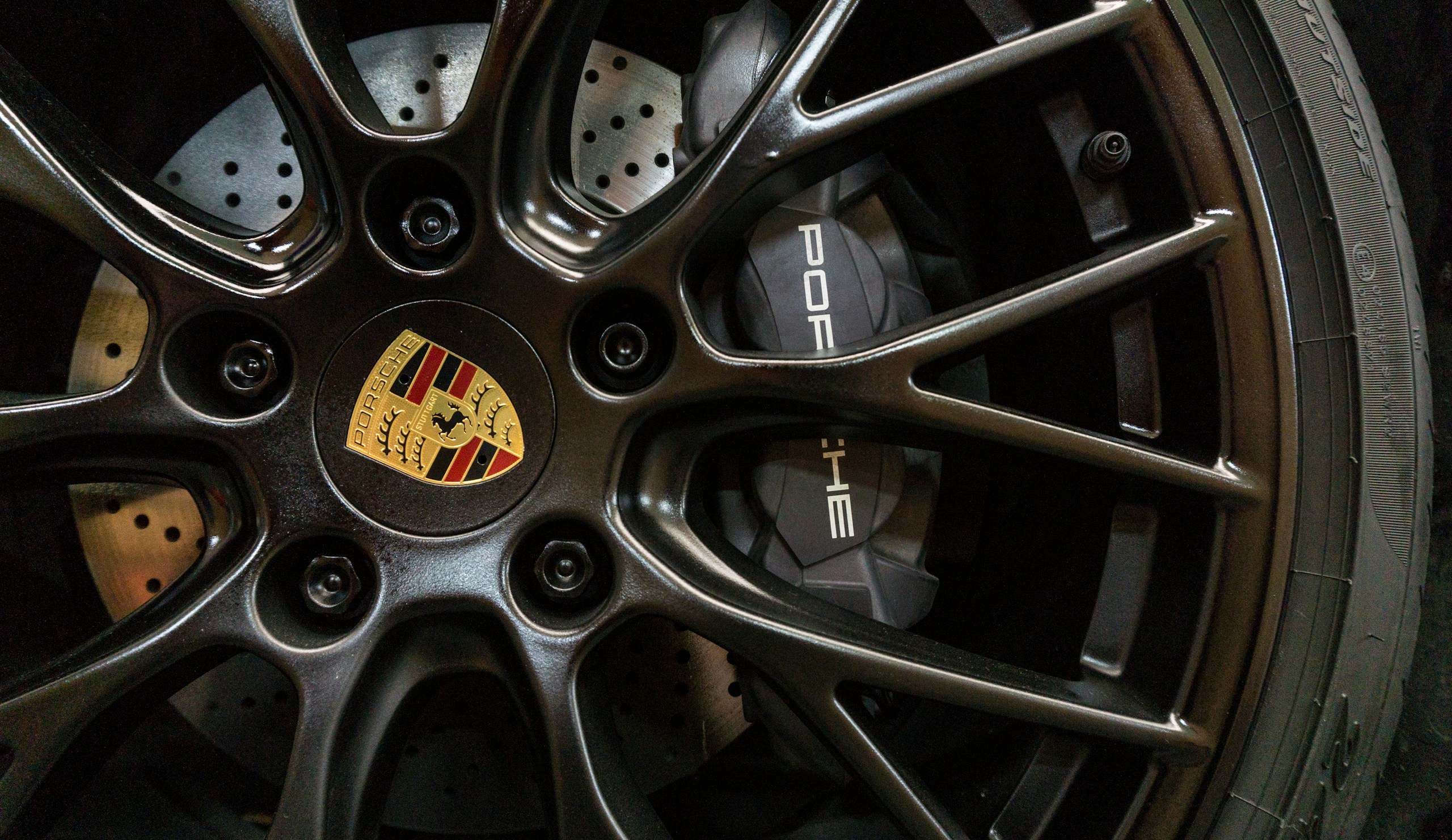
Performance trims sit in their own category. M, AMG, RS and Porsche systems use larger multi-piston calipers and pads built for much higher temperatures, and those pads cost more to make. Switching a European car to a cheaper or lower-dust compound can work, but it can also change pedal feel and noise. Our estimates use pads that meet your model's manufacturer specifications, with genuine OEM priced on request.
When do rotors have to be replaced?
When they measure below the minimum thickness the manufacturer sets, or when they're cracked, deeply scored, heat-spotted or uneven enough to cause a pulsation. The minimum is usually cast or stamped into the rotor itself, often marked MIN TH with a number in millimeters. We measure with a micrometer at several points around the friction surface and compare the lowest reading to that number.
Size is the other half of rotor cost. A heavy SUV like a Range Rover, Cayenne or Escalade needs big rotors to soak up heat, and bigger means more iron, more machining and more freight. Some Mercedes-AMG and BMW M models go further with two-piece rotors: a cast-iron friction ring mounted to an aluminum hat. They save weight and handle heat well, and they cost more to replace.
Resurfacing isn't a free pass either. Machining removes metal, and the rotor still has to be above its discard thickness when it comes off the lathe. Some composite rotors aren't meant to be machined at all. That's why a pads-only quote can be honest on one car and wishful on another.
How do wear sensors and electronic parking brakes add cost?
Both add parts or labor that a basic car doesn't need. On many European cars, the wear sensor is a small wire loop in a plastic tip that sits in the pad. When the pad wears far enough, the rotor grinds through the tip, the circuit breaks and the dash warning comes on. After that the sensor is finished, so it's replaced along with the pads. The number and placement of sensors vary by model, which is one reason two quotes for the same car can list different sensor counts.
Electronic parking brakes move the cost into labor and tooling. Small motors in the rear calipers hold the pistons, and on many models they have to be retracted with a scan tool before the old pads come out, then recalibrated afterward. That takes time, and skipping it can damage a caliper motor, which turns a pad job into a caliper job.
Why do performance and carbon-ceramic brakes cost so much more?
Because the parts are made in smaller numbers from more expensive materials, and they're inspected differently. Carbon-ceramic rotors, sold as PCCB on Porsche and offered on some BMW M, Mercedes-AMG and Audi RS models, don't wear like iron. They lose mass as the material oxidizes with heat, so thickness alone tells you very little. On many systems the minimum allowable weight is etched into the rotor, and checking it means cleaning and weighing the rotor or using the maker's own gauge.
Driven on the street, a carbon-ceramic system can last a long time. Driven hard on a track, it can wear much faster, and a set of replacement rotors is one of the biggest brake bills a car can produce. Condition, not mileage, should decide when they're replaced, and you should see the readings before anyone orders parts.
Why do brake quotes differ so much between shops?
Mostly because they describe different jobs. One quote covers front pads only. Another covers pads, rotors and sensors on both axles plus a fluid flush. Both can be right for the car, but they can't be compared until the scope matches. These are the lines that usually change:
- Axles: front only, rear only or both
- Rotors: measured and replaced as needed, replaced by default, or resurfaced
- Parts tier: genuine OEM, OEM, or an OEM-equivalent part built to spec
- Sensors and hardware: included or left off
- Brake fluid: flushed with the correct spec, or not mentioned
- Scan tool steps: parking brake service mode and warning resets
What's the right way to compare brake quotes?
Get both in writing, line them up item by item and match the scope before you look at totals. Then ask three questions of each: which rotors were measured and what did they read, which parts tier is quoted, and what warranty covers the work. Fluid deserves its own question. Brake fluid absorbs moisture from the air, and water drags its boiling point down. Federal safety standard FMVSS 116 requires DOT 4 fluid to boil no lower than 446°F when fresh and 311°F once it has taken on moisture, which is why makers schedule it by time.
At KJLux we measure first, then give you a free, itemized written estimate that marks each item as needed now or safe to schedule later, and nothing starts without your approval. Bring us a written dealer quote and we'll beat it. If your brake repair qualifies, our 36-month/36,000-mile nationwide limited warranty backs it, with the full terms on the service warranty page. To get a number before you visit, send your VIN through our quote request form. For a line-by-line method that works on any repair, read how to read a dealer service quote.
Questions about this topic
Why do brakes on a luxury SUV cost more than on a sedan?
Weight. A large SUV carries far more mass into every stop, so it needs bigger rotors, larger pads and stronger calipers to manage the heat. Bigger parts cost more to make and ship, and a heavy vehicle tends to go through them faster. Add an electronic parking brake and wear sensors, and the parts list grows again.
Is it worth paying more for genuine OEM brake pads?
Sometimes. Genuine pads reproduce the original feel, noise and dust exactly, which matters to some owners and on some performance cars. OEM-equivalent pads built to the manufacturer's specifications do the job well on most cars for less. We quote OEM or OEM-equivalent parts by default and price genuine OEM on request, so the choice is yours.
Can I replace only the front brakes?
Yes. Front and rear brakes wear at different rates, so servicing one axle at a time is normal. What you shouldn't do is replace one side of an axle. Pads and rotors are replaced in pairs across the same axle so the car stops straight. We measure all four corners and tell you which axle is actually due.
Do low-dust ceramic pads work on European cars?
They can, with tradeoffs. Ceramic pads cut the dark dust many European pads leave on the wheels, and they often run quieter. They can also feel different under your foot, especially when hot, compared with the low-metallic pads the car came with. If you're thinking about switching, ask us which pads meet your model's specs and what you'd notice.